
Vegan Winter Coats in Japan: How to Choose a Feather-Free Fill
A practical guide to Japanese clothing labels, kapok and feather-free insulation—with checks for linings and trims, plus an official maker example.
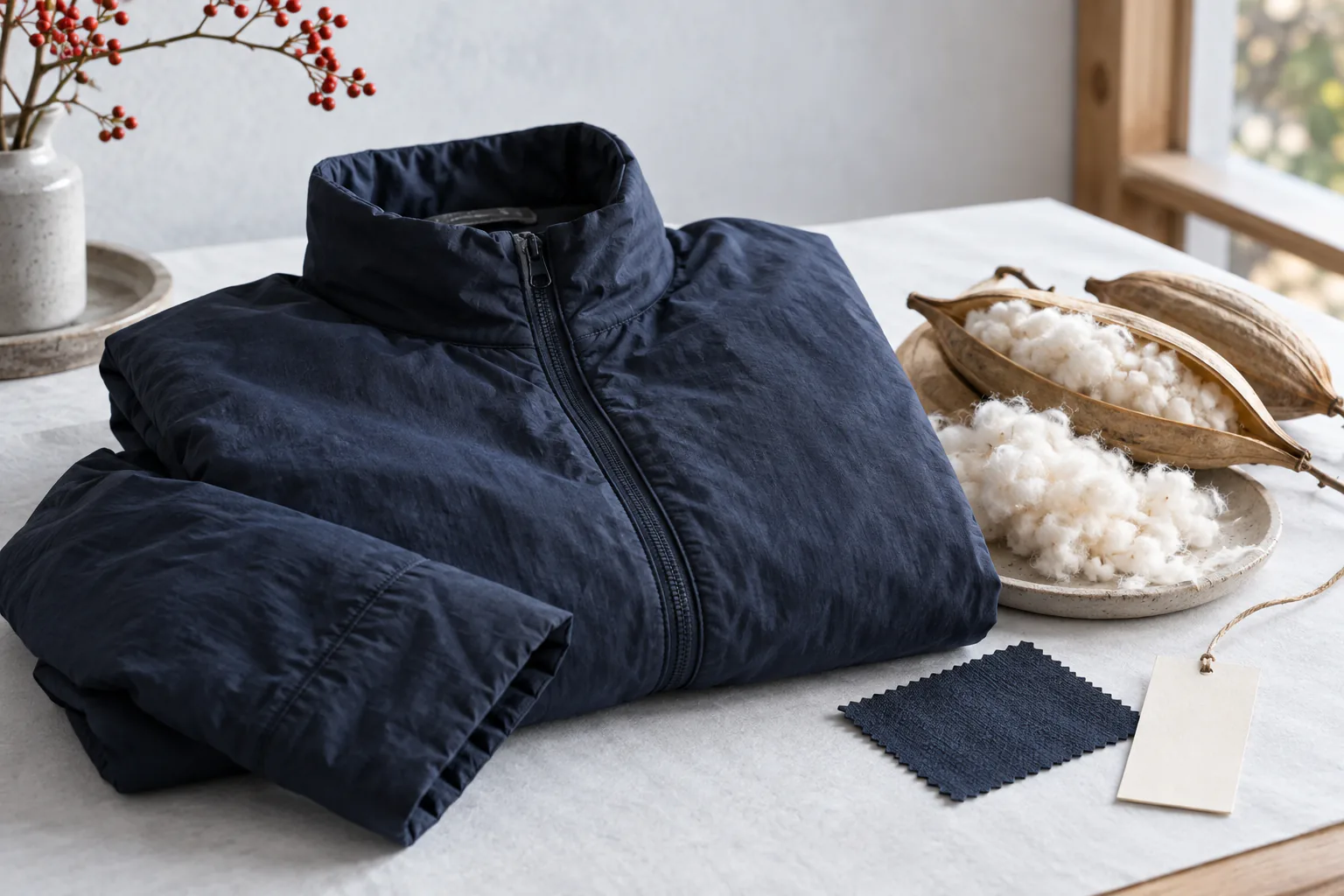
If you are looking for a vegan winter coat in Japan, check the insulation first: ダウン means down, フェザー means feathers, while 中綿 simply means “padding” and does not identify its source. Read the shell, lining and trim details, then ask for confirmation if the listing does not describe the whole garment. This guide offers a practical method and an example documented by official sources.
There is no single coat for every autumn or winter itinerary: city, altitude, rain, time outdoors and your own sensitivity to cold all matter. A light insulated jacket over removable layers can be more versatile than one very heavy garment. Before travelling, also check care instructions, weight and whether the coat can be repaired.
This is not a shop ranking or a wear test by our editorial team. It explains Japanese terms that appear on clothing labels, how to assess alternatives to down and what to ask a brand. Stock, sizes and compositions change; the useful reference is the current listing for the exact style, not an old collection page.
Japanese terms for feathers and animal fibres
On a label or product page, look for ダウン (down), フェザー (feather) and その他の羽毛 (other feathers): these indicate animal-derived filling. Wool and related fibres may appear as 毛 or 羊毛, ウール, カシミヤ, モヘヤ, アンゴラ, アルパカ or キャメル; silk may be listed as 絹 or シルク. For leather and fur, also check descriptions for 革, 皮革, レザー, 毛皮 and ファー.
Japan’s Consumer Affairs Agency publishes an English guide to textile-goods labeling. It explains that products covered by the labeling rules must show fibre names and their blend percentages, as well as applicable care instructions. Its tables include terms for wool, cashmere, silk, down and feathers. The official guide helps decode the vocabulary; it does not certify a coat as vegan.
That distinction matters: a textile composition label is not a vegan certification for the whole product. A tag may clarify the main fabric without describing every button, edge, patch, secondary filling or adhesive. If a page only says “eco”, “natural”, “plant-based” or “animal-free”, ask which parts the claim covers and whether it includes the lining, hood and trims.
Kapok and alternative insulation: what the maker says
One alternative to down is kapok, a plant fibre obtained from the seed pods of the kapok tree. It may be used on its own or blended with other fibres, so the fibre name alone cannot tell you the complete composition, warmth, water resistance or durability of a coat. Check the technical listing and care instructions for the specific style.
KAPOK KNOT describes its “Kapok Down” as an insulating sheet made from kapok and recycled polyester, developed with a Japanese textile manufacturer. It is a concrete example of filling that the brand says replaces feathers with a declared blend: plant-derived does not mean “100% plant-based”, and the filling alone does not establish that every coat component is vegan.
The official page we checked for a women’s hooded jacket displayed “Sold out”. For accuracy, we cite it as a materials example, not as an available purchase or a commercial recommendation. The listing can change, be replaced or disappear; if you are interested in the style, check current stock and the composition on the maker’s site before planning a visit or order.
“Down alternative” and “vegan” are not automatic synonyms. Synthetic filling may contain no feathers, but the whole garment still needs checking; plant fibre may be blended with polyester or paired with a synthetic coating. A brand page documents the maker’s stated materials; it is not an independent audit or a certification that applies to every item the company sells.
A practical checklist before you buy
Before buying, use this five-part check: 1) identify the filling composition; 2) inspect the shell and lining; 3) look for fur edging, leather inserts or patches; 4) check the hood, cuffs, buttons and decorations; 5) ask whether glue or unlisted components are animal-derived. Save the product link and the reply you receive with the exact style name.
Check the outer shell and lining separately. Nylon, polyester or cotton names a fibre, but a water-repellent treatment, coating or membrane may have a separate composition. For a travel purchase, compare weight, packability, washing instructions and drying time too. Do not infer technical performance from a photograph or a promotional phrase.
Give small details one last look: collar, hood, drawcord, cuffs, zipper pull, buttons, patches and decorative stitching may use different materials from the coat body. If in doubt, contact customer service and ask about the exact product and variant. A general reply about a brand or collection may not answer the question for the item you selected.
Vegan and sustainable are separate criteria. Avoiding feathers or wool addresses an animal-related choice; it does not by itself prove that a material has a low environmental impact, is recyclable or will last. When comparing coats, consider durability, repair options, warranty, care and replacement parts. Be cautious with absolute claims when a page does not explain which components or data they cover.
A useful question to ask in Japanese
If you want to ask in a Japanese shop, you can show this sentence: 「このコートの中綿・裏地・付属品に、動物由来素材は使われていますか?」 It means, “Does this coat’s filling, lining or trim contain animal-derived materials?” To be more specific, add: 「羽毛(ダウン・フェザー)は使われていますか?」, meaning “Are down or feathers used?” Also point to the exact colour, variant or product photo.
Frequently asked questions
When shopping online, open the listing for the colour and size you plan to buy, not only the collection overview. Look for composition, care instructions, returns and seller contact details; ask before checkout if essential information is missing. For a physical shop or pop-up, verify the address and hours on the official site on the day of your visit: this guide does not verify local stores or stock.
Does 中綿 mean a vegan filling? No. It tells you that the garment has padding, but not whether it is polyester, kapok, feathers or a blend. Look for the fibre names and percentages, then check the lining and other components. If the listing is incomplete, ask the maker before buying.
Is kapok always 100% plant-based in the finished product? No: the fibre is plant-derived, but a commercial insulation can be blended, as in KAPOK KNOT’s documented example with recycled polyester. A coat with kapok filling is not automatically vegan if the shell, lining, details and trims are not also explained.
Editorial verification and sources
Is a vegan coat automatically sustainable? Not necessarily. Animal-free choices and environmental assessment are different questions: consider lifespan, repairability, fibre origin and end of life without turning one label into a guarantee. Editorial check: 25 September 2026. The cover is an original illustrative editorial image, not a photograph of the cited style; official sources and the product listing were checked on that date.