
Vegan bags in Japan: how to read materials and labels
Japanese terms, a buying checklist and a LOVST TOKYO example: distinguish synthetic leather, a vegan product and claims to reconfirm.
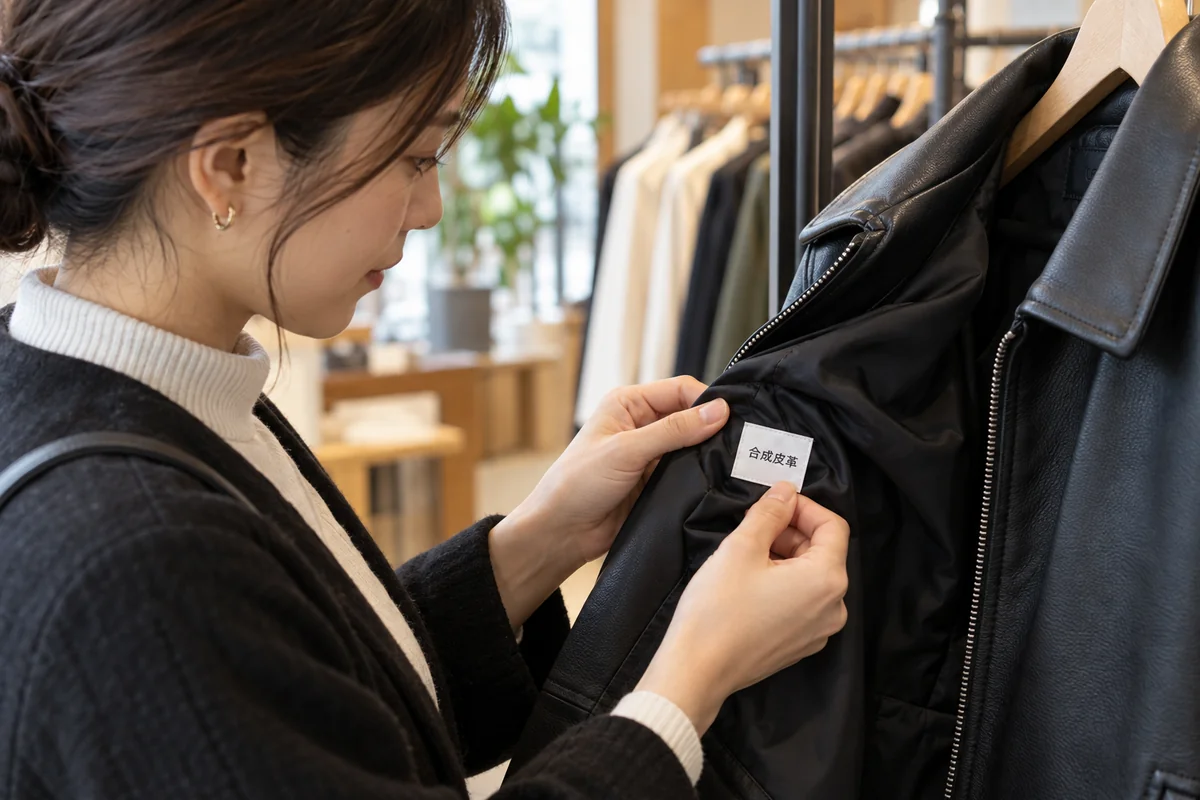
Illustrative scene generated with AI: reading a garment label. It does not represent a LOVST TOKYO product.
To choose a vegan bag in Japan, check the exact model and every component: exterior, lining, handles, strap, decorative patches and adhesives. 合成皮革 means synthetic leather, not vegan certification for the whole product. This guide offers a checking method, useful Japanese terms and a real LOVST TOKYO example, without promising availability.
The aim is not to buy something simply because you are travelling. It is to distinguish a documented answer from an appealing description. This is not an editorial product test: we have not tried the bag mentioned here or inspected its factory production. Brand information is the manufacturer's own declaration, while the checklist is a practical evaluation process.
Leather and synthetic materials: vocabulary to recognise
In the Consumer Affairs Agency's official table for leather clothing, 牛革, 羊革, やぎ革, 鹿革, 豚革 and 馬革 mean cattle, sheep, goat, deer, pig and horse leather respectively. 合成皮革 is the synthetic-leather label; 人工皮革 is permitted for a particular synthetic structure. We use this table as vocabulary, not bag certification.
Product descriptions may also use 本革, meaning genuine leather, and フェイクレザー, meaning fake leather. The latter commercial term can help you search for alternatives, but does not answer questions about every component. A photograph cannot establish material origin either: a smooth surface, uneven grain or natural-looking colour is not sufficient evidence.
Question 9 in the Consumer Affairs Agency's official FAQ explains that synthetic bags fall outside the particular regulated bag category described there. Do not expect identical labels on every bag or treat an absent entry as vegan confirmation. This is reading guidance, not legal advice.
From model to components: a four-part check
Before asking questions, record the model name, colour and product code, or save its exact link. An answer about a collection can be less useful than one about the individual item. In a shop, photograph the label with staff permission; online, keep the product page and checking date. These records also help if you postpone the purchase.
- Check the exterior and bottom reinforcements, not just the most visible panel.
- Read the composition of the lining, inside pockets, handles and removable strap.
- Inspect edges, decorative labels, patches and contrasting details.
- Ask whether the vegan declaration includes adhesives, coatings and finishes.
This list does not imply that every accessory contains animal ingredients. It prevents a leap from “the exterior is synthetic” to “the entire bag is vegan”. If the seller does not know about a component, ask for a manufacturer check. An incomplete answer remains incomplete: you need not interpret it as yes or accuse staff of making a claim they did not make.
A specific question to show in a shop
You can show this question prepared by our editorial team: このバッグは、表地・裏地・持ち手・装飾・接着剤を含め、動物由来の素材を使っていますか? It means: “Does this bag use animal-derived materials, including the exterior, lining, handles, decorations and adhesives?” This is more concrete than “is it eco-friendly?” and invites a detailed answer rather than suggesting your preferred answer in advance.
If the answer only covers the outer fabric, identify the remaining components and ask whether written confirmation is possible. Keep two goals separate: understanding the material and deciding whether you actually need the bag. To prepare more questions before travelling, use the resources in Learn Japanese.
LOVST TOKYO and aplena: what the product page actually declares
One documented example is LOVST TOKYO's Apple 2-Way Tote Bag. Its page lists aplena as 合成皮革 for Black and Off White, and 人工皮革 for Khaki Brown and Dark Navy, with recycled poly-suede lining and sewing in Guangzhou, China. These are the brand's model-specific statements, not our independent test.
The official aplena page describes an animal-free material made in Japan, using discarded Aomori apples and replacing part of the resin's raw materials with plant-derived components. That does not mean “100% apple” or “plastic-free”. The material's origin and the place where the bag is sewn are different facts.
We therefore do not automatically attribute every characteristic of one raw material to the finished bag. Ask about the model and finishes you want. Vegan and environmentally friendly are also separate criteria: assessing environmental impact requires comparable information, not simply a plant name. We do not calculate a footprint or assign sustainability scores here.
Before buying: actual use, photographs and conditions
The link documents an existing product, not guaranteed stock, delivery or presence in a physical shop. Before planning a visit or placing an order, select the variant and recheck price, availability, timing, shipping and return conditions. If a measurement or description is unclear, ask the seller to clarify rather than filling the gap with an assumption.
For travel use, consider your actual load: phone, wallet, bottle, and perhaps a laptop with its case. Measure bulky items and compare them with the opening, not only the bag's outer dimensions. If you can try the bag, check strap position and pocket access. A vegan choice can still be impractical for your itinerary.
When shopping online, ask for photographs of unseen areas such as the base, interior and strap attachments. An extra photograph does not certify materials, but helps you ask precise questions. Make two columns for comparison: what the manufacturer declares and what is missing. Do not fill the second with assumptions borrowed from a different model.
Care and support without universal treatments
Follow the care instructions for the variant you buy. Do not choose a cleaner or cream just because its packaging says “leather”: ask whether it suits that coating and check its composition if you want care products consistent with your vegan choice. We do not prescribe a universal treatment because materials and finishes may need different instructions.
Keep the label and instructions, and check how to contact support before discarding the packaging. If a detail does not match the product page, document it and ask questions before using the item. Do not assume returns, repairs or a replacement strap are included: read the seller's conditions. Postponing a decision is sensible when an essential answer is missing.
A checklist to save before purchasing
- Have I identified the exact model, colour and variant?
- Have I checked visible parts and asked about undocumented components?
- Does confirmation cover the whole bag or only its exterior material?
- Have I separated declared features, unanswered questions and availability to reconfirm?
- Do the dimensions, care and sale conditions fit my needs?
For a wider comparison, explore Vegan fashion, our guide to materials and brands in Japan, and our guide to coats without down or feathers. The method remains the same: start with a specific product, read what is declared and ask about what is not documented. Travelling vegan does not require a compulsory shopping list.
Frequently asked questions
Does 合成皮革 mean the whole bag is vegan?
No. It identifies a synthetic material, not the lining, details or adhesives. Use the word to start checking and ask for confirmation covering the whole model.
Is apple leather always plastic-free and eco-friendly?
No. A commercial name does not establish full composition or environmental impact. In aplena's case, the official description refers to partial replacement of the resin's raw materials: we do not describe it as plastic-free.
Can I buy the LOVST model immediately?
We do not confirm real-time stock. The product is documented on the official website, but colour, availability and conditions need checking before purchase. We do not promise a shop visit without an up-to-date address and confirmation.
Sources, checks and cover
Documentary check: 2 October 2026. Primary sources: the Consumer Affairs Agency for vocabulary and the scope of the cited labelling guidance; LOVST TOKYO for the model page and aplena description, linked in the relevant paragraphs. There are no affiliate links or editorial wear tests. The checklist and Japanese question are original editorial tools, not manufacturer statements.
Illustrative cover generated with AI for Nippon Vegan Guide: a person checks the label of a faux-leather jacket. The person, garment and label are fictional; the image does not document a shop, a LOVST TOKYO product or aplena material. The illustrated wording does not certify the entire garment.