
Vegan Shoes in Japan: How to Read Sneaker Labels
Terms such as 合成皮革 do not certify an entire shoe. A practical guide to Japanese labels, components to check and one model listed by an official store.
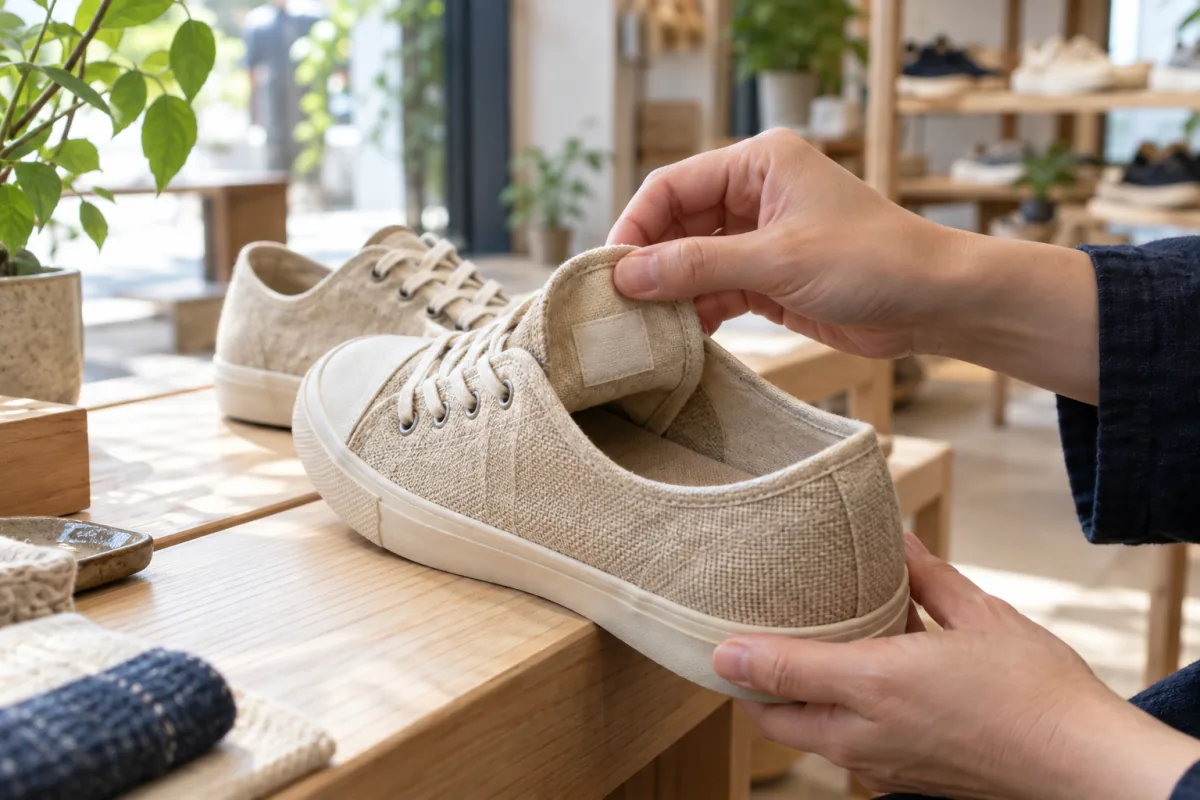
Original AI-generated editorial image showing a fabric sneaker and the act of checking its label; it does not depict a real product, shop or model.
To choose vegan shoes in Japan, do not stop at 合成皮革 (synthetic leather): check the lining, insole, adhesives and finishes too. Japan’s Consumer Affairs Agency specifies how some upper and sole materials should be labelled, but that label alone does not certify an entire sneaker as vegan. One concrete example is 8000Kicks Japan’s official Explorer V2.0 listing, which describes hemp, algae and natural-rubber materials. This guide gives you a practical way to read the labels and decide what to ask.
This guide was checked on 16 October 2026 against the Consumer Affairs Agency, the official 8000Kicks Japan shop and Vans Japan’s Japanese-language FAQ. It is not a wear test or a brand ranking: company descriptions are presented as manufacturers’ claims, not independent certifications. Prices, colours, sizes and availability can change, so check the page for the exact model and variant before buying.
Japan’s CAA sets quality-labelling rules for some footwear. In the section on shoes, it specifies 合成皮革 for the upper material when it is synthetic leather; a technical note permits 人工皮革 for a particular non-woven substrate construction. For soles, the regulation distinguishes terms such as ゴム底 (rubber sole) and 合成底 (synthetic sole). These are material names, not ethical labels or a statement that every part is free from animal-derived ingredients.
What Japanese labels actually tell you
Do not turn the difference between 合成皮革 and 人工皮革 into a verdict about the whole product. They are categories for upper materials under Japanese labelling rules; they do not automatically describe the lining, laces, insole, heel counter or adhesive in the same way. The rule gives you a concrete term to look for, but it does not replace the model’s full product information or an answer from the manufacturer.
On a product page, 甲皮 or 甲材 may refer to the upper, 底材 to the sole, 裏地 to the lining, and 中敷き or インソール to the insole. Terms such as 天然皮革, 本革, 牛革, 豚革, 羊革 and 山羊革 refer to animal leather. If the composition is stated only for the upper, do not automatically extend that information to the rest of the sneaker.
This caution also matters when the upper is canvas or a material described as synthetic. The fabric name does not answer questions about glue, dyes, treatments, coatings, reinforcements or small components. A company may sell different models, and materials can vary between colours or seasons. Read a “vegan” claim as applying to the specific model and the information actually published—not automatically to the brand’s whole catalogue.
Before paying, check six things: (1) upper and overlays; (2) lining and insole; (3) laces, tongue and heel counter; (4) outsole and bonded components; (5) patches, logos or leather details; and (6) adhesives, dyes and finishes if excluding every animal-derived ingredient matters to you. If the page is silent, contact customer service with the exact model, colour and product code. Keep the reply.
You can ask in Japanese: 「この靴の甲材だけでなく、裏地・中敷き・接着剤にも動物由来の素材は使われていますか?」 It means: “Besides the upper, are animal-derived materials used in the lining, insole or adhesives?” To ask about dyes, add 「染料」; for finishes, 「仕上げ材」. A specific question is more useful than the word vegan alone, especially when a brand sells both leather and vegan-labelled models.
A checklist for the whole sneaker
Vans Japan’s official FAQ shows why verification should be product-specific: the company says it is very difficult to guarantee that no animal-derived component is used throughout the manufacturing process, and mentions adhesives, dyes and hardening agents in its aim to develop vegan-friendly products. This is a general statement from the brand, not a verdict about any particular shoe. For your purchase, the specific product page and any reply from customer service matter most.
One example listed by a Japan-facing store is the beige-and-green Explorer V2.0 from 8000Kicks Japan. The shop’s homepage places its collection under “VEGAN SHOES” and uses the phrase “100% plant-based”; the product page then describes materials and parts of the sneaker. It is useful to examine because it pairs a category claim with more detailed information, but it remains the manufacturer’s commercial description—not an independent audit.
A documented example: 8000Kicks Explorer V2.0
The Explorer V2.0 page says the outer fabric is 100% hemp and that 92% of the other parts are natural materials. It also says the outsole incorporates 10–20% Bloom, an algae-based material, with natural rubber for the rest; the top of the insole is 100% hemp, with non-animal felt underneath and sponge in the middle. The page does not detail every adhesive, thread or treatment. If you need every component confirmed, ask the manufacturer.
At the time of checking, the Japanese page showed a price of ¥21,800 and size options from 23 to 29 cm. A listed price and size selectors do not prove that every size is available at checkout: confirm the colour, size and cart before relying on this option. We do not call the model “certified”; we report the vegan and plant-based classification used by the seller and the materials its product page makes explicit.
One more practical detail for people visiting Japan: the purchase page says it ships within Japan only. It is an online shop, not proof that the model is displayed in a physical store or available to try on in a particular city. If you hope to buy during a trip, verify the delivery address, timing, exchange policy and availability before ordering; do not plan a detour to a shop without official confirmation.
The CAA also lists care instructions for shoes with synthetic-leather uppers: remove dirt with a damp cloth, avoid leather creams or oils, keep the shoes away from fire and dry them in the shade. These are not universal instructions for every vegan shoe: hemp canvas, coated materials and different soles may need specific care. Follow the manufacturer’s guidance for the exact model you bought and test cleaners on a hidden area first if advised.
Availability, sizing and care
Vegan and sustainable are not synonyms. A shoe without animal-derived materials can still contain synthetic fibres; a plant fibre alone does not guarantee lower impact, long life or repairability. Alongside composition, consider comfort, intended use, care, replacement laces or insoles, outsole durability and return conditions. The most consistent choice is one that fits your criteria and that you can wear for a long time, not one supported by a single promotional word.
To compare materials and accessories, continue to the Vegan fashion section, read our guide to Japanese materials and brands, and compare its method with our article on coats without down. The same question applies: what does the maker state about this exact item or model, and which parts remain undocumented? If you are travelling, save the reply and product link before you leave; a photo of the label can help you continue the check later.
Does 合成皮革 mean the whole shoe is vegan? No. It is the term used by the CAA for synthetic upper material under certain labelling conditions; it does not certify the lining, adhesives, insole or other components. Check the full product page and ask the seller what its claim covers.
Frequently asked questions
Is the Explorer V2.0 an independently certified vegan shoe? 8000Kicks Japan lists it among its vegan shoes and describes plant-based materials; the product page also lists specific parts and composition. We did not verify an independent certification, so we treat this as the manufacturer’s claim. Ask about any components not listed before purchasing.
Can I find it in a physical shop or have it shipped overseas? The page we checked is an online store and says shipping is within Japan; it does not by itself confirm a physical shop with try-on stock or international shipping. Check the current channel, size and terms with the company before arranging a purchase.
Editorial check: 16 October 2026. We consulted the Consumer Affairs Agency’s footwear labelling rule, the official 8000Kicks Japan · Explorer V2.0 page, the official shop homepage and Vans Japan’s FAQ. The price and sizes are those shown on the page at the time of checking; stock, terms and composition should be checked again on the seller’s site. The cover is an original AI-generated editorial image: it illustrates a fabric sneaker and the act of checking its label, but does not depict a real product, shop or model.