
Vegan sushi-making in Asakusa: nigiri, maki and matcha at Sushi Matcha
A 90-minute plant-based workshop in Tokyo, held in a shared class: programme, address, published price and what to check before booking.
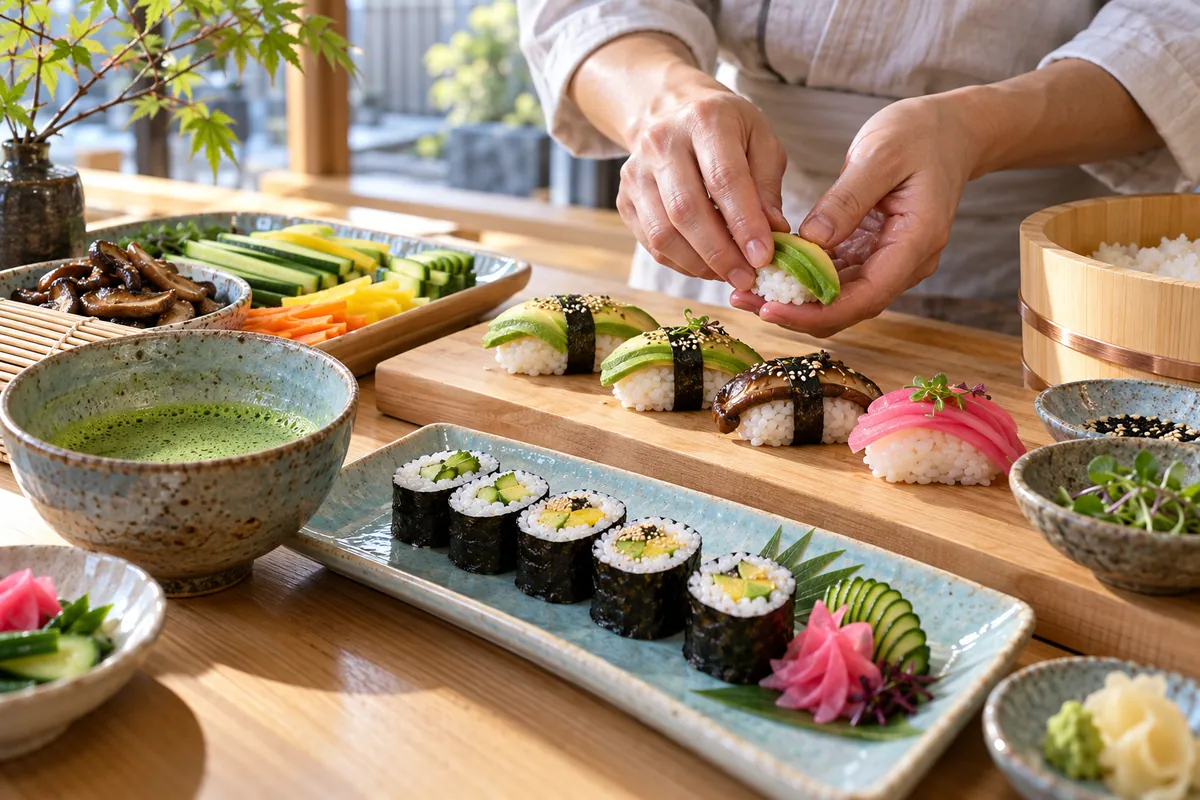
Original AI-generated editorial image illustrating a plant-based sushi and matcha lesson; it is not a photograph of the Sushi Matcha venue or class.
To learn how to make vegan sushi in Tokyo, Sushi Matcha offers a 90-minute workshop in Asakusa, taught in English. You shape vegetable nigiri, roll maki and whisk matcha. The official listing gives a price of ¥12,000 per person and describes the selected class menu as 100% plant-based. It is a shared class, however: other guests in the same group, and potentially at the same table, may make traditional sushi with fish.
This is a practical guide based on information published by the activity, not a first-hand report from a Nippon Vegan Guide visit. The duration, menu, price and terms below were checked on 8 October 2026 and may be updated by the organiser. We do not present it as an exclusive class or a separate kitchen: the official page describes one shared session, with different ingredients for guests who select the plant-based menu.
A plant-based menu in a shared class
That distinction matters before you book. The menu selected for the workshop is described as using plant-based ingredients only, while the class and table are shared with people who may prepare sushi with fish. If you want a room without animal products, a separate work surface or simply more distance from seafood ingredients, contact Sushi Matcha before paying and ask what can be arranged for your chosen date.
The published programme starts with a welcome and a short introduction to the day’s ingredients. With the instructor’s guidance, you shape nigiri and roll maki; the group enjoys what it has made and finishes by whisking a bowl of matcha. A recipe card is also included. This is therefore a hands-on lesson rather than a demonstration to watch from the side.
The exact plant-based ingredients change with the season and availability. The page says the class uses plant-based ingredients, but does not promise a fixed combination of vegetables or an identical recipe at every session. It is better to think of nigiri and maki as techniques you will try with that day’s ingredients, not as a permanent menu with guaranteed toppings. If there is an ingredient you must avoid, mention it in your request.
What happens during the 90 minutes
The class is marked for beginners and does not require previous cooking experience. The published maximum is 20 guests, and instruction is in English. That is a capacity limit, not a promise that every session will have 20 people; the actual group depends on bookings. Travellers with omnivorous companions may appreciate the mixed-menu format, but should check in advance which option each person will select.
The listed address is 1-10-16 Hanakawado, Taito City, Tokyo 111-0033, in Asakusa. The activity recommends arriving about ten minutes before the start so you can find the meeting point and get settled. Enter the full address in your map app: Asakusa alone covers a large area and may take you away from the correct entrance.
According to the official directions, the venue is about 30 seconds from the north exit of Tobu Asakusa Station. The page also lists the Tokyo Metro Ginza Line, Tobu Skytree Line, Toei Asakusa Line and Tsukuba Express as serving the area; actual walking times depend on your station, exit and route. If you have luggage, check the map on the day and leave time to find your way around the neighbourhood.
Where it is and how to get there
You can fit the class into a broader day by reading our guide to vegan cooking classes in Japan, which compares different formats but does not replace each organiser’s current listing. For other meals, use our Where to eat directory; our vegan recipes can help you revisit ingredients and techniques at home. Check addresses, hours and availability separately: an internal link is a guide, not a reservation.
The class listing shows ¥12,000 per person. The activity’s main site asks visitors to select a date to confirm availability and the final total, so treat this as the published price at the time of checking, not an unchanging quote. Before paying, review the checkout summary, number of participants, any children’s rates and the currency charged. We did not verify availability for a particular date.
Price, booking and cancellation
Booking starts by choosing a date on the official page, which states that confirmation is instant after purchase. The presence of a calendar does not prove that a place is still available on your travel date: select the actual date and wait for confirmation before arranging transport. If the time or meeting point is unclear in the checkout summary, ask the organiser directly before completing payment.
The class page states that cancellation is free up to 24 hours beforehand. Still read the terms shown at checkout, because the conditions attached to your actual booking are the ones that apply. Save the confirmation and the activity’s contact details on your phone. If you booked for several people, check that the plant-based menu selection was applied to each person who needs it.
The words 100% plant-based describe the menu selected for this workshop according to the organiser; they do not mean the entire studio or every Sushi Matcha activity is vegan. The same page says the session is shared with guests who may prepare traditional sushi with fish. This detail lets you assess the experience transparently, without turning a vegan option into a claim that the whole venue is plant-based.
Vegan does not automatically mean suitable for every allergy
The page allows guests to submit dietary and allergy requests, but does not publish a guarantee of separate equipment or no cross-contact. If you have an allergy, ask which ingredients will be used that day, how tools and surfaces are cleaned, and whether working near other preparations is compatible with your needs. A vegan label is not an allergen-free menu or a medical food-safety procedure.
The programme includes a sake toast, and the activity says a non-alcoholic option can be requested. If you do not drink alcohol, add that request to your booking and confirm it on arrival. Avoid assumptions here too: the plant-based menu describes the class ingredients, while drinks and individual requests may have their own conditions.
You can write in English before booking or show staff this question: 「このクラスの植物性メニューについて、当日の食材とアレルギー対応を確認できますか?」, meaning, “Could you confirm the day’s ingredients for the plant-based menu and how allergies are handled?” To ask about shared equipment, add 「調理器具や作業台は共用ですか?」, “Are utensils and worktops shared?” For a serious allergy, do not rely on a generic translation; wait for a specific answer you understand.
How to prepare and plan the rest of your Tokyo visit
When travelling in Japan, even ingredients that seem secondary deserve attention: stocks, sauces and seasonings can have different compositions. The Japan National Tourism Organization’s guide explains why it helps to ask specifically about ingredients; for this class, Sushi Matcha’s direct confirmation about the menu and requests is what matters. Do not infer health or logistics details from another guest’s review, because groups and preparations vary.
Before setting out, save the address, booking confirmation and official class link. Check the time in Tokyo’s local time zone, plan the route from your chosen station and arrive a few minutes early. If learning a particular technique is your priority, you can ask in advance how much time is devoted to nigiri and maki. The published programme includes both, but does not guarantee a number of pieces or minutes for each preparation.
In short, Sushi Matcha is a concrete option for trying plant-based sushi and matcha in Asakusa, with a published duration and price and English-language instruction. The point to weigh carefully is the shared format, clearly stated on the page: the selected menu is plant-based, but fish ingredients may be prepared in the same space. Whether it suits you depends both on the kind of activity you want and on your personal needs.
Frequently asked questions
The answers below summarise the activity’s published information and do not replace checking your date and booking terms.
Is the whole class vegan?
Is the whole class vegan? The selected menu is described by the organiser as 100% plant-based. The class is shared, though, and other guests may make sushi with fish; it should not be described as an entirely vegan venue or an environment without animal ingredients.
How long is it, and how much does it cost?
How long is it, and how much does it cost? The official listing says 90 minutes and ¥12,000 per person. Availability and the final total are checked by selecting a date on the site. We did not choose a date or confirm a place during our editorial check.
Is it suitable for people with allergies?
Is it suitable for people with allergies? The page accepts dietary requests but does not specify a cross-contact guarantee or separate utensils. Contact the activity with the allergen and ask how it is handled before buying; if the response is not sufficient, do not assume the class is suitable.
Editorial check and image
Documentary check completed on 8 October 2026 using the official class listing and Sushi Matcha website for programme, price, address, access and published terms. The JNTO guide is included as context for checking food while travelling. Details are the organiser’s statements; availability, seasonal ingredients and the final total should be reconfirmed at booking. The cover is an original AI-generated image illustrating vegetable sushi and matcha; it does not show the venue, instructors or a dish served in the class.