
Recipe
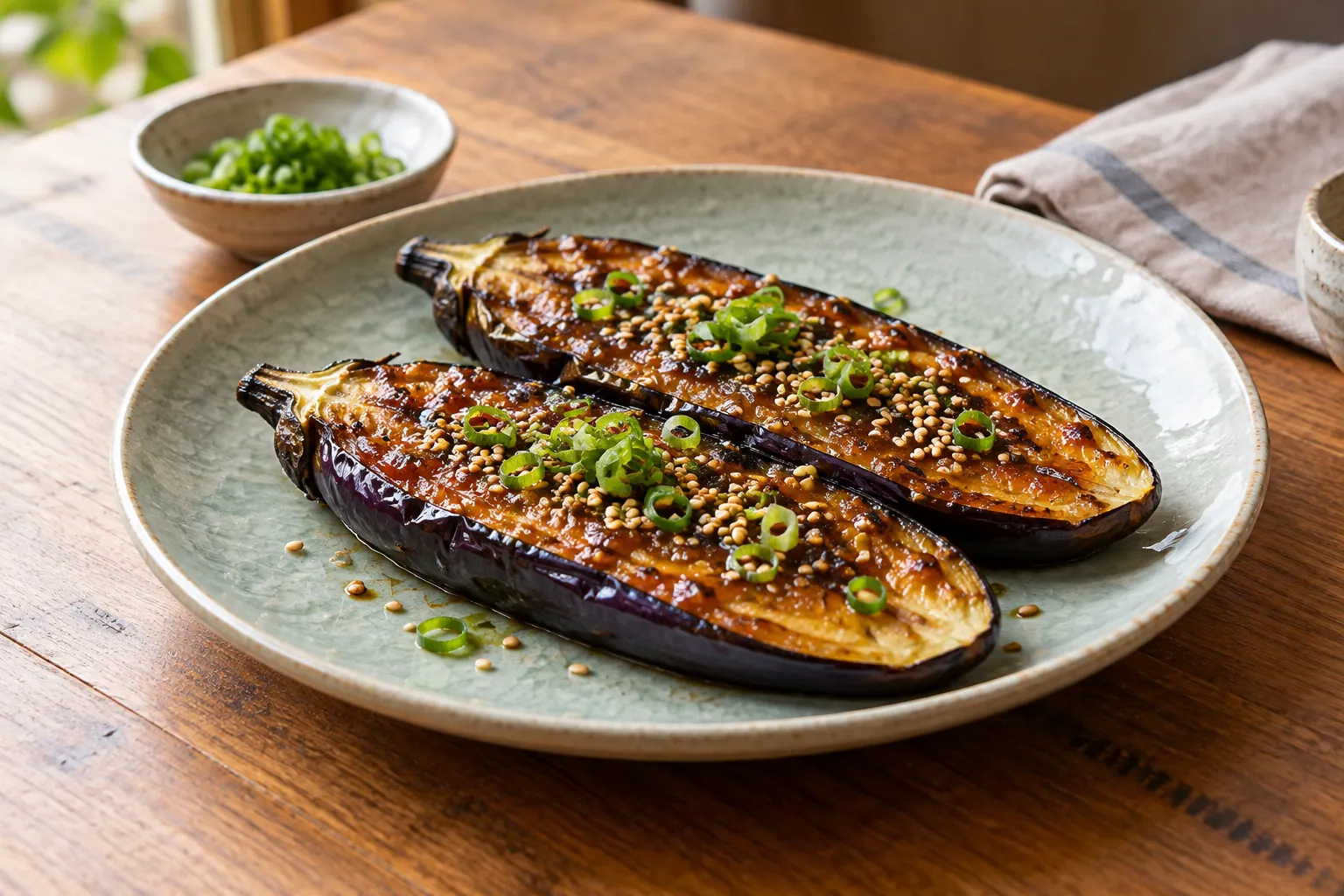
Vegan nasu dengaku: Japanese miso-glazed aubergine
Tender roasted aubergine with a glossy miso glaze: a vegan take on nasu dengaku, with no dashi, for two and ready in about 40 minutes.
Practical guide
Complete method
Vegan nasu dengaku is a Japanese-style aubergine dish with tender flesh under a savoury, gently sweet miso glaze. This oven version serves two as a substantial side, uses no broth and is best served warm with rice and vegetables. Roasting needs less oil than pan-frying and gives the aubergine time to soften while it keeps its shape.
Japan’s Ministry of Agriculture, Forestry and Fisheries (MAFF) describes Kamo-nasu no dengaku as a Kyoto speciality: round Kamo aubergine is cooked slowly and served with miso reduced with sake, mirin and sugar. The official page also mentions lightly toasting the topping and finishing with sesame. We take the pairing of soft aubergine and aromatic miso as inspiration; the ingredients, quantities and oven method below are our adaptation, not MAFF’s official recipe. (MAFF · Kamo nasu dengaku)
This version uses common aubergines rather than traditional Kamo nasu, a round, firm-fleshed local Kyoto variety. Slim Japanese aubergines soften quickly; one larger globe aubergine also works when cut into two or four pieces. There is no need for dashi: miso already brings savoury depth. JNTO’s guide notes that dashi and seasonings may contain fish even when it is not visible in a dish; this recipe does not require stock. (JNTO · ingredients and dashi)
For two side portions, use two medium Japanese aubergines, about 500 g in total, or one large aubergine weighing 350–400 g; one tablespoon neutral oil; two tablespoons plain white miso; one teaspoon red miso, optional; one tablespoon mirin; one tablespoon water; one teaspoon sugar or maple syrup; one teaspoon toasted sesame oil, optional; and one tablespoon sesame seeds. Thinly sliced scallion is an optional garnish.
Choose firm aubergines with smooth skin and an intact stem; smaller ones cook evenly and are easy to serve in halves. Wash and dry them, then trim only the stem. If you have a particularly wide globe aubergine, cut it lengthwise into quarters so heat reaches the centre before the surface dries. Leave the skin on: it helps support the flesh during roasting.
Check the miso before you start. Plain miso made from fermented soy, rice or barley is different from ready-seasoned soup pastes, which may include dashi or fish extract. Read the ingredient list and choose a product without animal-derived ingredients; if the wording is unclear, do not assume it is vegan. White miso is usually milder and sweeter, while a little red miso adds depth and salt. If you do not have red miso, use white miso alone. (JNTO · ingredients and dashi)
Heat the oven to 220°C conventional or 200°C fan. Place the aubergines cut-side up and score the flesh in a diamond pattern, making cuts about 5 mm deep without piercing the skin. The scoring helps heat reach the centre and gives the glaze small grooves to settle into. Brush with the oil and do not add salt yet: miso is already savoury, and you can adjust the seasoning at the end.
Arrange the halves on a lined tray, cut-side up. Roast for 22–28 minutes, depending on their thickness and variety. They are ready when a knife tip slides easily into the thickest part and the flesh looks soft while the skin still holds its shape. If the centre resists after 22 minutes, continue and check every four minutes. Do not extend roasting just to brown the top; the glaze provides the finish.
While the aubergines roast, whisk the white miso, optional red miso, mirin, water and sugar in a small pan. Warm over low heat for two or three minutes, stirring, until the sugar dissolves and the glaze looks smooth and glossy; it does not need to boil. Turn off the heat and add sesame oil if using. To avoid mirin, replace it with one tablespoon water and half a teaspoon rice vinegar, then taste and adjust sweetness.
When the flesh is soft, spread the glaze over the cut surface with the back of a teaspoon. Cover it evenly without letting much sauce run onto the tray, where it could burn. Return the aubergines to the oven and broil for one or two minutes, watching closely: the miso should bubble in places and take on colour, not turn black. Broiler distance varies, so stop as soon as the topping smells toasted.
Let the dish rest for two minutes before serving. Finish with toasted sesame and, if you like, finely sliced scallion. A short rest helps the flesh hold together and lets the glaze cling. If the flavour is too intense, serve it with plain rice; for a deeper taste next time, add a little more red miso rather than increasing the salt across the whole recipe.
Texture is a more reliable test than the timer: a thin aubergine may cook sooner, while a very fleshy one needs a few extra minutes. If the surface dries before the centre is tender, lower the oven to 200°C and continue roasting. If the flesh is soft but the glaze is still pale, use the broiler in short intervals. A teaspoon of water loosens an overly thick glaze; a runny one can be thickened by warming it for another half-minute.
Serve nasu dengaku warm beside rice, chilled tofu or seasonal vegetables. For a simple meal, add a bowl of rice and a crisp salad, avoiding packaged sauces whose ingredients you have not checked. To build a Japanese plant-based menu, pair it with vegan kinpira gobo or mushroom takikomi gohan; both recipes appear in the “Continue exploring” section at the bottom of this page.
Store leftovers in a sealed container in the refrigerator and eat within two days. The flesh softens further and the glaze settles, so the dish is best freshly made. Reheat in a moderate oven or a covered pan with a tablespoon of water; add sesame afterwards. A microwave is convenient but can make the aubergine very soft. Do not leave cooked food at room temperature for long periods.
The recipe contains no animal ingredients when the selected miso and mirin are suitable, but this is not an allergen-free or cross-contact claim. Miso and soy sauce can contain soy and, depending on the product, gluten-containing grains; sesame is a separate allergen. Read labels and cross-contact warnings, especially when cooking for someone with allergies. JNTO recommends explaining dietary needs and checking dashi and dish bases; no stock is needed here, but packaged ingredients still deserve a check. (JNTO · ingredients and dashi)
Editorial verification: 2 November 2026. The MAFF page documents the local dish, traditional ingredients and finishing method; JNTO’s guide was consulted for cautions about dashi and hidden ingredients. The method, quantities and timings here are an original editorial proposal, not a MAFF recipe or a recipe tested by our editorial team. The AI-generated cover is illustrative and does not document a photographed preparation.
From the kitchen
Ingredients
- 2 medium Japanese aubergines (about 500 g) or 1 large aubergine (350–400 g)
- 1 tbsp neutral vegetable oil
- 2 tablespoons plain white miso, without dashi (check the label)
- 1 teaspoon red or dark miso, optional
- 1 tablespoon mirin
- 1 tablespoon water
- 1 teaspoon sugar or maple syrup
- 1 teaspoon toasted sesame oil, optional
- 1 tbsp toasted sesame seeds
- 1 small scallion, optional
From the kitchen
Method
- 01
Heat the oven to 220°C conventional or 200°C fan. Wash and dry the aubergines, halve them lengthwise and score the flesh in a diamond pattern without cutting through the skin. Brush with oil and place cut-side up on a baking tray.
- 02
Roast for 22–28 minutes, until a knife tip enters the thickest part easily. If needed, continue in four-minute intervals; timing depends on variety and thickness.
- 03
In a small pan, mix the white miso, optional red miso, mirin, water and sugar. Warm over low heat for 2–3 minutes, stirring until smooth and glossy; turn off the heat and add optional sesame oil.
- 04
Spread the glaze over the cooked aubergines and broil for 1–2 minutes, watching continuously. Remove as soon as the miso bubbles and lightly toasts.
- 05
Rest for two minutes, garnish with sesame and scallion, and serve warm with rice or vegetables.
Practical questions
Frequently asked questions
Is nasu dengaku always vegan?
No. This recipe is a vegan version without dashi, but other preparations may use miso pastes seasoned with fish stock or add different ingredients. Check the miso label and all other products.
Can I use a large aubergine instead of Japanese aubergines?
Yes. One 350–400 g globe aubergine can be cut into two or four pieces. Adjust the cooking time to its size and make sure the thickest part is tender before adding the glaze.
How do I know when it is cooked?
A knife tip should enter the thickest part easily. Timing is only a guide because variety and thickness change the cooking time. After adding the miso, use the broiler only in short intervals.
Can I make it without mirin?
Yes. For this amount, replace mirin with one tablespoon water and half a teaspoon rice vinegar; taste the glaze and adjust sweetness. If avoiding alcohol for a specific reason, check the seasoning labels as well.
Editorial check
Sources and checks
Checked on 2 November 2026 · By Alex Peretto
An original adaptation inspired by the traditional method documented by MAFF; quantities and timing are an editorial proposal, not an official recipe or a kitchen-tested preparation. The cover is an illustrative AI-generated image.