
Recipe
Vegan Nikujaga: Japanese Potato Stew with Fried Tofu
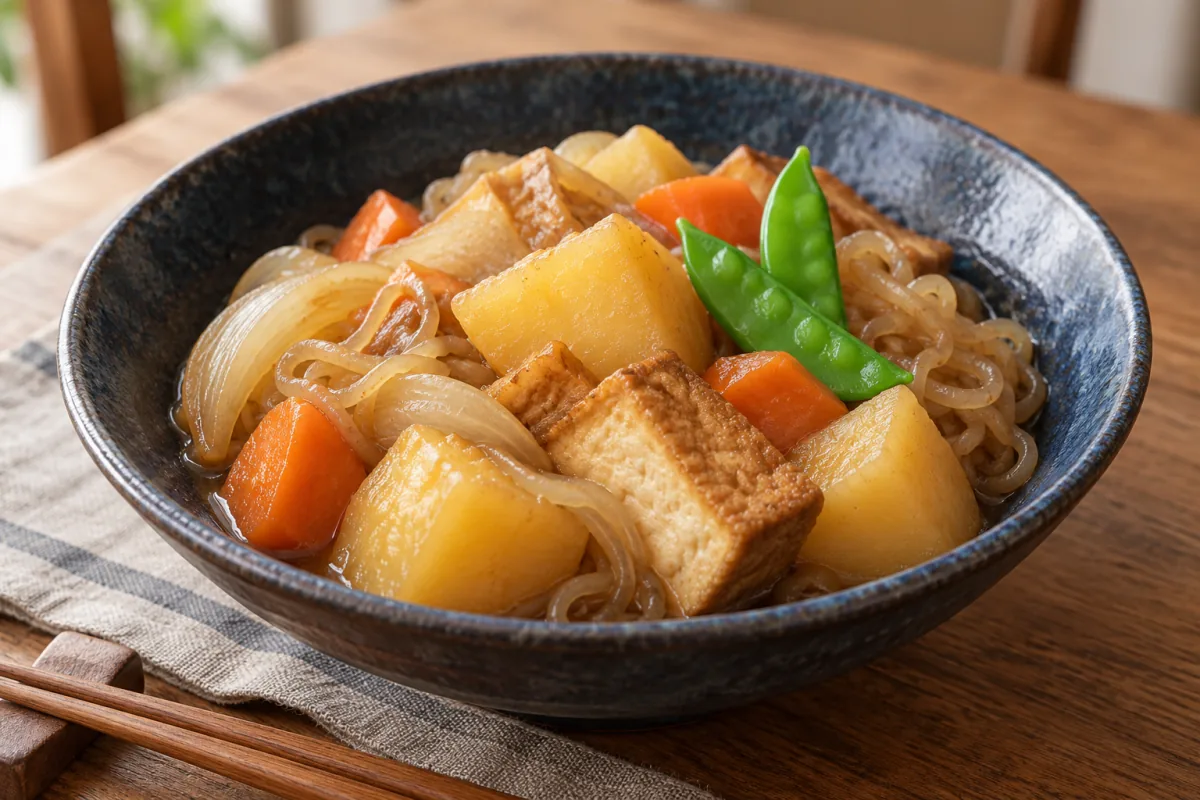
Potatoes, carrots, onion, shirataki and fried tofu in kombu broth: an original editorial vegan nikujaga for two, without fish dashi.
Practical guide
Complete method
Vegan nikujaga is a Japanese-style potato stew made here without meat or fish-based dashi. For two people, it combines potatoes, onion and carrot with atsuage (thick fried tofu), shirataki and a light kombu broth. Shoyu and mirin give the stew its gently sweet-savoury flavour. Allow about 45 minutes for preparation and cooking, plus 30 minutes to infuse the kombu.
Japan’s Ministry of Agriculture, Forestry and Fisheries (MAFF) describes nikujaga as a home-style dish and publishes a two-serving recipe with beef, potatoes, onion, carrot, kelp, soy sauce and sugar. We use that ingredient profile to identify the dish, but do not reproduce its method or attribute this vegan version to the ministry. Replacing beef with atsuage and shirataki, along with the quantities and steps below, is an original editorial adaptation. (MAFF · nikujaga)
The word nikujaga combines niku (meat) and jagaimo (potato), a reminder of the familiar meat-based version. Here it names a plant-based interpretation of a home-style stew; it does not mean that the classic dish is vegan. That distinction matters if you are looking for a Japanese vegan recipe to make for someone who enjoys comfort food while still describing the culinary reference accurately.
For two servings, prepare 350 g potatoes, one medium onion, one carrot, 150 g atsuage, 100 g shirataki, 300 ml water, a piece of kombu about 5 × 5 cm, one teaspoon neutral oil, one tablespoon shoyu, one tablespoon mirin and one teaspoon sugar. Snow peas are optional. The broth quantity is deliberately modest: the ingredients should simmer, not float in soup.
Choose potatoes of similar size and cut them into pieces about 3 cm across. A floury variety tends to break down sooner, while a firmer one is more likely to keep its edges; either way, check doneness with a fork. If the pieces vary widely, the smaller ones will soften first. Cut the carrot thinner than the potato so both cook in roughly the same time without the carrot turning mushy.
To make the broth, place the kombu in 300 ml cold water and leave it in the refrigerator for about 30 minutes. Remove the seaweed before heating the liquid and use the infusion as the base of the stew. It is a light broth, not a concentrate, so shoyu, onion and tofu remain noticeable. If you also want to use shiitake, prepare a separate plant-based broth and expect it to change the aroma. (JNTO · dashi)
Dashi is not automatically vegan. JNTO warns that Japanese broths and sauces may contain fish; its guide to dashi distinguishes kombu and shiitake infusions from preparations made with katsuobushi or dried sardines. For this version, do not use ready-made stock unless its label makes the ingredients clear. If you choose a powder or packaged sauce, read the complete ingredient list rather than relying on the name on the front. (JNTO · vegan guide,) (JNTO · dashi)
As a terminology check, we also consulted the local English–Japanese ingredient dictionary from Itadakihealthy. One listed term is 魚のだし (sakana no dashi), meaning fish stock. It is useful vocabulary to recognize, but labels may use other names and compound ingredients. A glossary can help with language; it does not replace checking the whole package or asking the manufacturer. (Itadakihealthy · glossary)
Shirataki is made from konjac and adds a springy texture against the soft potatoes. Drain and rinse it, following the packet directions. If the packing liquid has a strong smell, you can briefly blanch the noodles for a couple of minutes and drain them again; this is not necessary for every product. Cut them into shorter lengths so they are easier to pick up with chopsticks and distribute evenly through the stew.
Prepare all the vegetables before turning on the stove. Peel the onion and cut it into thin wedges; peel the carrot and slice it diagonally or into half-moons about 1 cm thick. Peel the potatoes if you prefer a more even texture, then rinse and dry them. Regular cuts help them cook evenly, but the pieces do not need to be perfect cubes. Just avoid cutting them so small that they fall apart during simmering.
Pat the atsuage dry with kitchen paper and cut it into roughly 2 cm cubes. It has already been fried, so you do not need to treat it like raw meat or cook it for a long time before adding the vegetables. If the surface looks very oily, follow the product instructions and blot it gently; do not assume every atsuage has the same ingredients. Fried tofu and shoyu contain soy, so flag this allergen for anyone sharing the meal.
Warm the oil in a wide, heavy-bottomed saucepan. Add the onion and cook for two or three minutes, until it begins to turn translucent without browning. Add the potatoes and carrot and let them take on the flavour briefly, moving the pan or stirring gently. There is no need to form a crust: the goal is to coat the ingredients in a little oil before adding the liquid.
Pour in the kombu broth, shoyu, mirin and sugar. Stir once to distribute the seasoning and bring the liquid to a gentle simmer. If your shoyu is very salty, start with two teaspoons and adjust at the end. Mirin and some sauces vary by manufacturer; to keep the recipe vegan, check those labels too instead of assuming every product has the same formulation.
Set an otoshibuta, a drop lid used for simmering, over the vegetables. If you do not have one, use a round of parchment paper with a small hole in the centre and place a regular lid on top of the pan. The liquid should reach about halfway up the ingredients, not cover them completely. Keep the stew at a gentle simmer: a hard boil knocks the potatoes together and can break their edges.
After about 12 minutes, test the carrot and the largest potato with the tip of a knife. Timing changes with the variety, cut, pan and burner, so the minutes are a guide rather than a guarantee. If the centre is still firm, continue over low heat for a few more minutes. If the liquid is nearly gone while the potatoes are still raw, add a little hot water and lower the heat.
When the potatoes are starting to soften but still hold their shape, add the atsuage and shirataki. Gently shake the saucepan so the broth reaches the pieces on top; avoid vigorous stirring. Cover again and simmer for another 8–10 minutes, checking the bottom occasionally. The atsuage should warm through and take on some of the seasoning without becoming so soft that it falls apart.
The nikujaga is ready when a fork slides into a potato without effort but the piece stays intact. Taste the broth before adding more shoyu or salt: reduction concentrates the flavour, and the soy sauce may already be enough. For a glossier finish, remove the lid for the last few minutes and let some broth evaporate over moderate heat. Do not cook until the pan is dry; enough seasoning should remain to coat the ingredients.
Snow peas add a green accent. Blanch them separately for a few minutes and transfer them to cold water, or add them to the pan only at the very end. This helps them retain more colour and texture. Turn off the heat and leave the stew to rest for about ten minutes: the flavour settles and the ingredients continue warming in the remaining liquid. Serve warm rather than piping hot.
Serve the stew with plain Japanese rice; its savoury broth seasons the grains without the need for extra sauce. In the “Keep exploring” section you will find clickable links to three other plant-based recipes on the site, including kabocha no nimono, mushroom takikomi gohan and goma-dofu. These are possible pairings, not a required traditional set menu. If you are serving several dishes, keep the portions modest so they do not overwhelm the light kombu flavour.
For a lighter variation, reduce the atsuage and add more onion or carrot; for a deeper flavour, replace some of the water with verified vegan shiitake broth. Avoid adding commercial dashi without checking its ingredients. Shoyu may contain wheat, and mirin, atsuage and shirataki formulations vary by brand. If you have an allergy or coeliac disease, check the exact label and consider possible cross-contact from utensils.
Store leftovers in a shallow container once the strongest heat has gone and refrigerate them promptly. MAFF advises against leaving stews and other cooked foods in the pot for a long time; refrigerate them soon, eat them promptly and reheat the portion you plan to eat thoroughly. Checked on 19 October 2026, the sources support the base recipe, dashi cautions and storage advice. This specific combination and its quantities are an original adaptation, not a recipe tested in the editorial kitchen. (MAFF · food storage)
From the kitchen
Ingredients
- 350 g potatoes (2 medium; approximate weight)
- 1 medium onion (about 130 g)
- 1 medium carrot (about 80 g)
- 150 g atsuage, thick fried tofu (check the label)
- 100 g shirataki, drained weight
- 300 ml cold water
- 1 piece kombu, about 5 × 5 cm
- 1 tsp neutral vegetable oil
- 15 ml shoyu or soy sauce
- 15 ml mirin
- 1 tsp sugar
- 40 g snow peas or mangetout (optional)
From the kitchen
Method
- 01
Place the kombu in 300 ml cold water and steep in the refrigerator for about 30 minutes. Remove it before heating the broth.
- 02
Drain and rinse the shirataki according to the package. If the preserving liquid smells strong, blanch the noodles for two minutes and drain again.
- 03
Cut the potatoes into roughly 3 cm pieces, the carrot into 1 cm slices and the onion into thin wedges.
- 04
Pat the atsuage dry and cut it into roughly 2 cm cubes.
- 05
Heat the oil in a wide saucepan. Cook the onion for 2–3 minutes, then add the potatoes and carrot and stir gently.
- 06
Add the kombu broth, shoyu, mirin and sugar. Bring to a gentle simmer and cover with an otoshibuta or a round of parchment.
- 07
After about 12 minutes, check the potatoes. If they are still firm, continue cooking over low heat; if the liquid is running low, add a little hot water.
- 08
When the potatoes begin to soften, add the atsuage and shirataki. Cover and cook for another 8–10 minutes, until a fork slides in easily but the pieces hold their shape.
- 09
Taste the broth and adjust the shoyu. Add blanched snow peas if desired. Turn off the heat, rest for 10 minutes and serve with plain rice.
Practical questions
Frequently asked questions
Is this recipe vegan?
Yes. The recipe uses plant-based ingredients. Still check the labels on atsuage, shirataki, shoyu and mirin; if you have allergies, also check for cross-contact.
Is traditional nikujaga always vegan?
No. The MAFF recipe consulted contains beef, and some Japanese broths contain fish. This is a vegan reinterpretation made with kombu broth.
Can I replace atsuage with regular tofu?
Yes. Pat firm tofu dry, cut it into cubes and pan-fry it in a little oil before adding it to the stew. It will be less firm than fried tofu.
Do I need an otoshibuta?
No. Use a circle of parchment with a small hole in the centre and a regular lid. Keep the stew at a gentle simmer and make sure the pan does not dry out.
How should I store leftovers?
Transfer leftovers to a shallow container, let them cool briefly and refrigerate promptly. Eat them soon and reheat the portion thoroughly, following MAFF guidance.
Editorial check
Sources and checks
Checked on 19 October 2026 · Recipe and article by Alex Peretto
Original editorial recipe inspired by the general composition of nikujaga documented by MAFF; the official source uses beef and does not publish this vegan version. The quantities and method are an editorial adaptation, not kitchen-tested by the editorial team. Illustrative AI-generated cover.